
Why Your Blogging Niche Decides Your Income:
Your niche is the biggest financial decision you’ll make as a blogger, it sets your ceiling before you write a single post.
Most beginners choose a niche because it is a “topic I like.” A profitable blogging niche sits where your knowledge, audience demand, and buyer spending overlap.
At The Blogging Queen, founder Sherry Bennett has been building websites since the fall of 1996 and now sits in the top 1% of bloggers worldwide.
Want to learn more about Ms. Bennett? Google The Blogging Queen.
Below, she will walk you through a scoring framework, some validation steps, and various monetization paths.
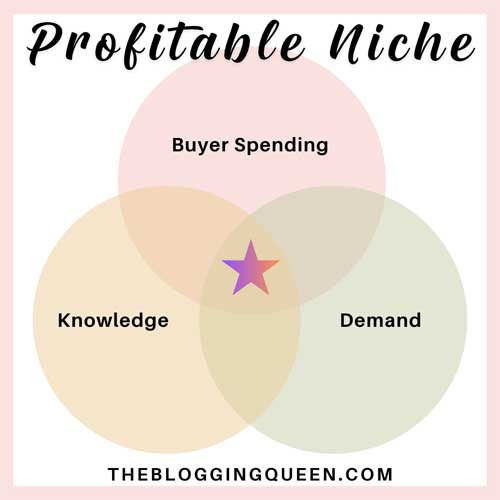
The Niche-Scoring Framework…
Five Factors That Predict Profit:
The most reliable way to choose a niche is to score it across five factors before you commit: interest, knowledge, credibility, demand, and purchasing power. Rate each from 1 to 5, then add them up.
Scoring Interest, Knowledge, and Credibility:
Interest keeps you writing when traffic is slow. Knowledge lets you say something useful. Credibility is whether readers trust you over the next site.
A common mistake is overrating interest. Ask instead: can I write 100 posts about this topic without running out of things to say?
- Interest: Could you write about this topic twice a week for years to come?
- Knowledge: Do you know more about this topic than the average reader?
- Credibility: Do you have any actual experience with this topic?
If any of these scores below 3, the niche will feel like a grind.
Scoring Demand, Competition, and Purchasing Power:
Demand is whether people search the topic.
Competition is how many strong sites are in the same niche.
Purchasing power is whether those readers actually spend money.
A niche with high demand and low buyer intent pulls traffic but rarely pays; modest traffic with strong buyer intent pays well. Most beginners chase volume and ignore intent, that’s the trap.
Blog Niche Research: How to Validate Demand Before You Write:
Blog niche research means confirming that real people search for your topic and that the searches come from buyers, not just browsers, before you write post one.
Start with free tools. Use Google Trends to check whether interest is rising, flat, or fading.
Next, read the search results. Big brands with huge teams mean a hard fight; thin, outdated pages mean you have room.
- Check search volume for 10 to 15 topic keywords
- Note keyword difficulty for each
- Scan the top results for weak spots
Those buyer-intent searches tell you whether a profitable blog niche is realistic.
Blogging Step-by-Step
A Top Selling Course from 7-figure Professional Blogger,
Sherry Bennett aka The Blogging Queen
Need help getting started? Consider our Top Selling course.
Learn how to do everything correctly from the beginning!
Save yourself the time and stress of having to start over
when you realize you have been listening to all the wrong people!
READ MORE…

Blog Niche Validation: Testing a Niche Before You Commit:
The 30-Day Niche Pilot Plan:
Treat the first month as a test, not a launch. The goal is learning and gathering information, not worrying about traffic.
- Pick one narrow angle. Choose a single subtopic, such as “budgeting for freelance designers” rather than “personal finance.” Narrow angles produce clearer signals.
- Publish 12 to 15 posts in a cluster. Cover one pillar post plus supporting posts that answer related questions, targeting specific search intent rather than broad essays.
- Set up measurement before you publish. Connect Search Console and Google Analytics to see impressions, clicks, and queries from day one. Add a simple email signup form to every post.
- Promote lightly and consistently. Share each post in two or three relevant communities or social channels. Don’t buy traffic; you want organic signals.
- Review at day 30 and day 60. Early signals are noisy, so give the cluster time to be indexed and accumulate impressions before you judge it.
The Signals That Matter – and The Ones That Don’t:
Beginners often watch the wrong numbers. Pageviews in month one are mostly noise. The leading indicators that predict long-term viability are:
- Search impressions trending up. Even without clicks, rising impressions mean the search engine is surfacing your pages for relevant queries.
- Queries matching your intent. If your posts appear for buyer-intent or problem-solving queries, the niche has commercial pulse.
- Click-through rate on at least a few posts. A handful of posts earning clicks from search beats one viral social spike.
What doesn’t matter yet: total pageviews, social follower counts, and comments. Those lag and can mislead you into quitting a viable niche or doubling down on a dead one.
Decision Rules: Commit, Pivot, or Walk Away:
Set your rules before you start so emotion doesn’t drive the call.
- Commit if impressions are climbing, at least a few posts earn clicks from search, and you see early email signups or monetization signals. Expand the cluster and build the next content tier.
- Pivot the angle if impressions are rising but clicks and signups are flat. The topic has demand, but your framing or audience may be off. Test a sharper sub-audience or a different content format before abandoning the niche.
- Walk away if impressions stay flat after solid posts have had time to be indexed, or if the queries you rank for have no buyer intent and no problem-solving intent. Walking away after 30 to 60 days is far easier and cheaper than walking away after investing the time in writing 50 posts. Time is money!
PRO TIP: Skipping validation is the costliest mistake new bloggers make.
They choose a topic and spend the time creating 50 posts,
then discover the topic has very few searches and no one buys anything.
Test small first, and let the results, not hope, tell you when to commit.
Profitable Blog Niche Ideas That Hold Up Long-Term:
The niches that last share one trait: steady, repeatable demand. They aren’t trend spikes. They’re topics people search every month, year after year.
Strong categories include health and wellness, personal finance, technology, travel, food, parenting, and personal growth. Each has buyer intent built in.
But don’t just copy a list. The best niche for you is one of these categories filtered through your own knowledge and credibility.
Evergreen Categories With Steady Search Demand:
Evergreen content answers questions that never go out of style. “How to budget,” “best protein sources,” and “how to fix a leaky faucet” always get searched year after year.
For profitable blog niche ideas, favor categories where the questions repeat and the answers need updating. That gives you a reason to refresh posts and stay relevant.
- Personal Finance: budgeting, side income
- Health and Wellness: fitness, nutrition, sleep
- Technology: software, gadgets, how-to’s
Pick one topic inside a larger category. “Personal Finance for Single Moms” beats the broader term “finance” every time.
Get our Occasional Newsletter with offers and updates. Unsubscribe at any Time.
Blog Monetization Strategies That Match Your Niche:
Blog monetization strategies ONLY work when they are relevant to your niche and of interest to your audience. The right model for the wrong niche still fails. Most guides list monetization options and stop there.
This section goes further: it explains the conditions each model needs, the audience size it typically requires, and realistic time-to-profit expectations so you can choose a path that fits your niche as well as your patience.
Match the model to intent first, then pressure-test it against the conditions below.
Affiliate Marketing: The Fastest Realistic Start:
Affiliate marketing rewards niches where readers compare before buying. It is usually the fastest path to first income because you can earn from buyer-intent posts without owning a product or building a large audience.
The conditions: your niche must have products people research, your posts must target comparison and “best” queries. Always be sure to disclose affiliate relationships clearly.
PRO TIP: Affiliate income depends on programs staying open and commission terms staying stable. Diversify across several programs rather than relying on only a few.
Display Advertising: Requires Volume Before Revenue:
Display ads reward volume, so they suit broad lifestyle topics. The conditions are demanding: you typically need substantial recurring traffic before ad networks will accept you, and revenue per visitor is usually very low. Most practitioners find that display ads only become meaningful after a site has built a large, steady audience over many months.
PRO TIP: Ads tend to slow your site and dilute reader trust. Most times the ads are NOT anywhere near being relevant to your niche or the content on your pages.
This makes them nothing more than SPAM… and for that reason, I never use them.
Digital Products: Trust Compounds:
Digital products reward trust, which takes time to build. The conditions: an engaged email list, a clear reader problem, and proof that your audience is looking for a deeper solution.
Creating a product takes real work, and launching to a cold audience rarely works. Build the list first… validate demand with a small offer or waitlist, then invest in creating the full product, such as an eBook.
Services and Sponsorships: Direct and Relationship-Driven:
Services can be the fastest path to income if you already have a network or a specific skill. The conditions: direct client demand and a clear offer. Sponsorships come later and require a recognizable, specific audience that a brand wants to reach.
Keep in mind… services trade your time for money and can pull you away from creating more content for yoiur blog. Sponsorships depend on relationships and can be seasonal.
The fastest path to income is usually affiliate marketing plus one digital product. Ads come later, once traffic is large enough to matter. Choose the model your niche’s intent supports, then give it the conditions it needs, audience, trust, and time, before you judge the results.
Competition Analysis and Differentiation: How to Stand Out:
Competition analysis means studying the sites already ranking for your keywords and finding the gaps they leave open.
Look at the top five results for your main keywords. Note what they have covered and, more importantly, what they have left out.
Then establish a clear difference and write a much better post.
- Deeper case studies than anyone else
- A specific audience the big sites ignore
- Fresher, updated information
What most guides miss is that you don’t need to beat the biggest site. You need to be the best answer for the specific reader.

Common Mistakes That Sink New Bloggers:
New bloggers fail for predictable reasons. Spotting them early saves years of wasted effort. Read our post: * Blogging Mistakes Beginners Make and How to Avoid Them
The biggest one is choosing a niche with no buyer intent. Traffic without spending power pays nothing. The second is chasing a trend that fades in six months.
Others include:
- Picking a topic you can’t sustain for more than a year
- Ignoring keyword research and writing blind
- Skipping validation and writing 50 posts on a guess
The fix is the same every time: score it, research it, test it, then commit. That order matters!
Treating a niche as permanent is another trap. Many successful bloggers start narrow, then expand once their blog takes off and they have built an audience.
PRO TIP: The fashion niche is one of those niches that easily lends itself to the eventual inclusion of beauty products as well, since beauty and fashion are so closely related.
Choosing a profitable blogging niche is a challenge, but it’s one you can solve with a clear process rather than guesswork.

About the Author: Sherry Bennett
Ms. Bennett is a Professional Blogger, who has been earning a living online with niche websites since October 1996.
Through hard work and dedication, she has turned her passion for blogging into a 7-figure business.. and you can do the same.
Read More
Have more questions? Need some answers?
Find me on Facebook:
Business Page: The Blogging Queen
Facebook Group: 7-Figure Professional Blogger – Sherry Bennett